Keywords
Transfection — the delivery of foreign genetic material into eukaryotic cells — is a fundamental technique in modern molecular biology, underpinning applications ranging from protein expression studies to gene therapy development. However, because transient transfection efficiency is inherently variable, quantifying the proportion of successfully transfected cells is essential for ensuring reproducibility and comparability across experiments.
Fluorescent reporter genes such as GFP and RFP are widely used as rapid, reliable indicators of successful gene delivery. Traditionally, flow cytometry has been the gold standard for quantifying transfection efficiency, but its high cost, large sample volume requirements, and steep learning curve present barriers for many laboratories. The LUNA-FX7™ Automated Cell Counter addresses these limitations by combining high-resolution image cytometry with dual-channel fluorescence detection, offering a streamlined benchtop alternative.
In this application note, we demonstrate the accuracy and flexibility of the LUNA-FX7™ for evaluating single-color (GFP or RFP) and dual-color (GFP+RFP) transfection efficiency using HEK293 cells. Quantitative performance was validated by directly comparing LUNA-FX7™ measurements against flow cytometry across all cell populations.
| Item | Details |
|---|---|
| Cell line | HEK293 (Human Embryonic Kidney 293) |
| Transfection reagent | Lipofectamine™ 3000 Transfection Reagent (L300001) |
| Plasmids | GFP-expressing plasmid; RFP-expressing plasmid |
| Slides | LUNA™ 1-Channel Slides |
| Instrument | LUNA-FX7™ Automated Cell Counter |
| Culture medium | DMEM supplemented with 10 % FBS |
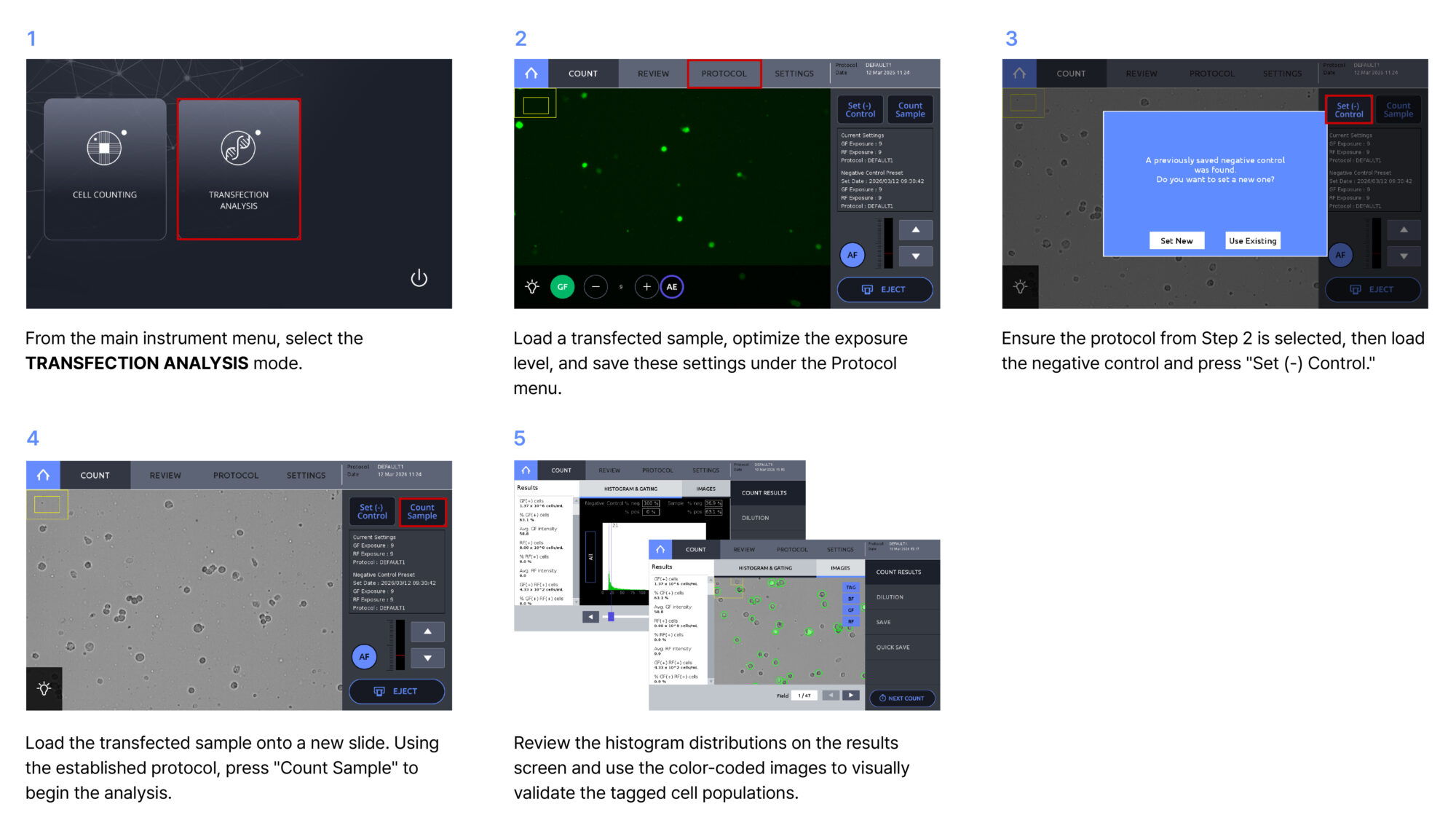
The LUNA-FX7™ demonstrated high sensitivity in detecting cells across a broad range of fluorescence signal intensities, successfully distinguishing transfected cells from background even when expression levels were low. Using the interactive histogram interface, users can directly control fluorescence detection boundaries to suit their experimental requirements.
Setting the threshold to a lower position captures both strongly and weakly expressing cell populations, ensuring maximum detection sensitivity. Conversely, raising the threshold applies a more stringent cutoff, restricting detection to cells with high fluorescence intensity and effectively excluding dim or weakly positive populations. The color-coded brightfield overlay images confirm that this histogram-based gating approach enables precise and user-defined isolation of target cell populations (Figure 1A and 1B). This flexibility is particularly valuable when comparing experiments with varying expression levels or when strict positive cell criteria are required.
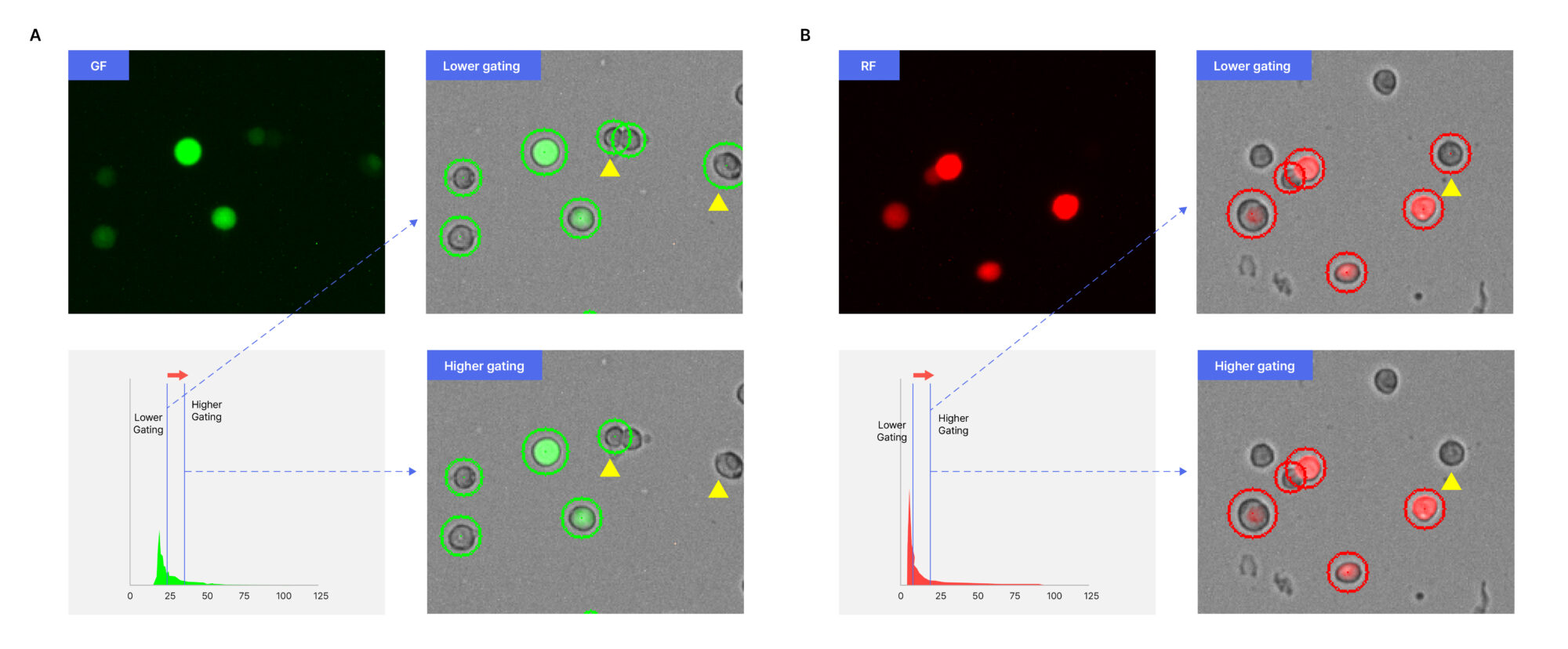
Figure 1. Representative fluorescence images of GF (A) and RF (B) and corresponding histograms illustrating Lower and Higher Gating thresholds. Dashed lines indicate the gate-to-image correspondence. Green and red circles denote detected GF+ and RF+ cells, respectively. Yellow triangles (▲) indicate cells detected exclusively under lower gating.
To validate the quantitative accuracy of the LUNA-FX7™, the same GF+, RF+, and GF+RF+ cell mixtures were analyzed in parallel using flow cytometry. LUNA-FX7™ measurements were plotted against flow cytometry values across all mixing ratios, and linear regression analysis revealed near-perfect correlations for all three cell populations: R² = 0.9856 for GF+ cells (Figure 2A), R² = 0.9913 for RF+ cells (Figure 2B), and R² = 0.9967 for GF+RF+ double-positive cells (Figure 2C). These results demonstrate that the LUNA-FX7™ produces quantitatively equivalent measurements to flow cytometry across single- and dual-color fluorescence channels, confirming its reliability as a benchtop alternative for transfection efficiency analysis.
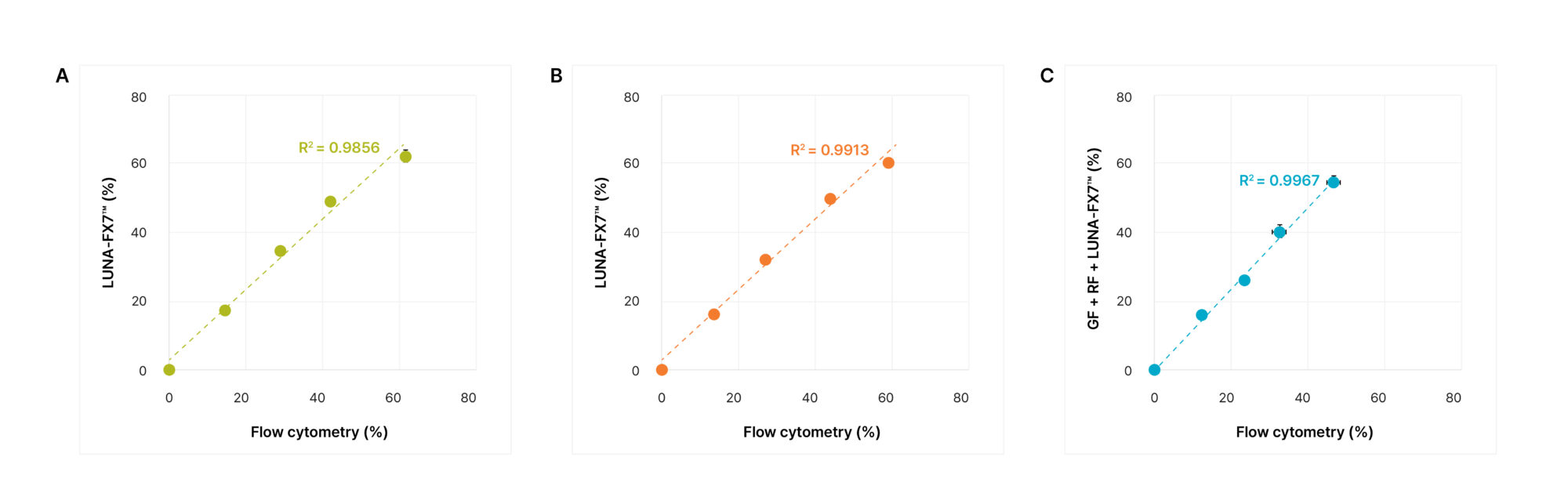
Figure 2. LUNA-FX7™-measured cell percentages were plotted against flow cytometry values for (A) GF+ (R² = 0.9856), (B) RF+ (R² = 0.9913), and (C) GF+RF+ double-positive cells (R² = 0.9967). Data points represent the mean ± SD of three independent replicates. Dotted lines represent linear regression fits.
The LUNA-FX7™ Automated Cell Counter offers a robust, user-friendly benchtop solution for accurate and flexible transfection efficiency evaluation. This application note demonstrates that the instrument reliably quantifies GF+, RF+, and GF+RF+ double-positive HEK293 cell populations with exceptional linearity (R² ≥ 0.98) across the full 0–100% expression spectrum. The interactive gating feature provides additional flexibility, allowing researchers to tailor detection thresholds to their specific experimental criteria — whether prioritizing sensitivity or stringency.
By analyzing 47 high-resolution images per sample, the LUNA-FX7™ ensures statistically robust results even for heterogeneous samples or experiments with low transfection rates, making it a practical and accessible benchtop alternative to flow cytometry for single- and dual-color transfection analysis.