Exosomes: Letters Sent by Cells, A New Key to Disease Diagnosis
2025-12-18

Exosomes: Letters Sent by Cells, A New Key to Disease Diagnosis

Can a Single Drop of Blood Detect Cancer?


Pancreatic cancer is often called a “silent killer.” Because it causes few symptoms in its early stages, diagnosis is frequently delayed, and the five-year survival rate remains below 10 %. Recently, research has drawn attention by demonstrating that early-stage pancreatic cancer can be detected with high accuracy using exosomes in the blood. Some studies have reported very high sensitivity and specificity in identifying stage I–II pancreatic cancer. However, it is important to note that this approach has not yet been adopted as a standardized clinical test.

Even so, it is true that technology enabling the early detection of cancer using only a blood sample—without a tissue biopsy—is moving closer to reality. This is the future being shaped by exosome-based liquid biopsy.

What Are Exosomes? The Secret Messengers of Intercellular Communication


Exosomes are tiny vesicles, about 30–150 nm in size, secreted by nearly all types of cells. They are too small to be seen with a conventional light microscope, but they can be found in various body fluids such as blood, urine, and saliva. Inside exosomes are proteins, lipids, and diverse nucleic acids (mRNA, microRNA, and DNA). ⅱ,ⅲ
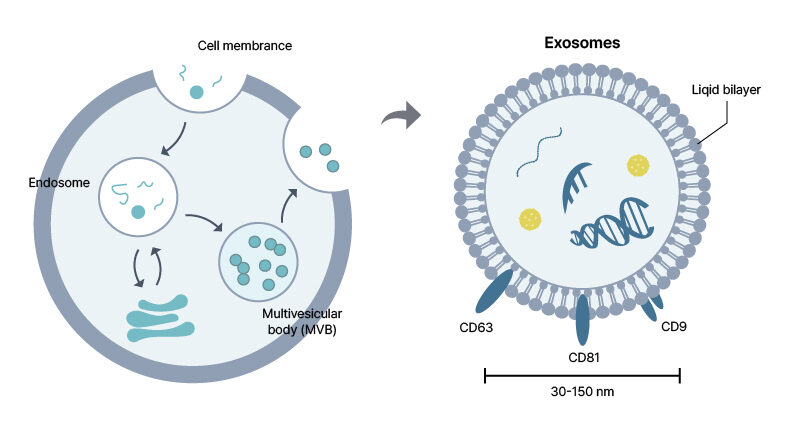
The Structure and Biogenesis of Exosomes


Figure 1. The Structure and Biogenesis of Exosomes


Importantly, exosomes are not merely cellular debris. Rather, they function like letters—carrying a cell’s condition and information and delivering it to other cells as a means of intercellular communication.

Cancer cells also release exosomes, and these exosomes may contain:

  • Cancer-associated proteins
  • Distinctive microRNA expression patterns
  • Specific genetic alterations (e.g., EGFR, KRAS, etc.)

These biological differences provide a scientific basis for using exosomes as biomarkers for cancer diagnosis.

Are Exosomes the Key to Liquid Biopsy?


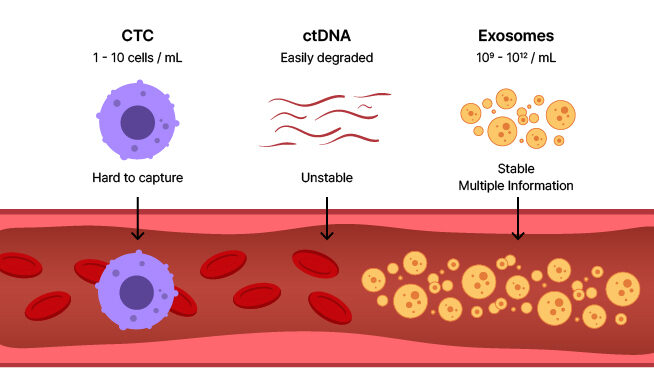
Liquid biopsy is a technique for diagnosing cancer using blood or other body fluids. Currently, the three main types of biomarkers used are as follows:
    CTCs (Circulating Tumor Cells)
    This approach captures intact cancer cells that are circulating in the bloodstream.
    • Advantage : Enables analysis of whole cells
    • Limitation : Extremely rare in early-stage cancer, making detection difficult

    ctDNA (Circulating Tumor DNA)
    This method analyzes fragments of DNA released from dead tumor cells.
    • Advantage : Useful for analyzing genetic mutations
    • Limitation : Low abundance and a short half-life may reduce sensitivity in early-stage cancer

    Exosomes
    Exosomes are vesicles continuously secreted by living cells. They are gaining attention because:
    • They are present in substantial amounts even in 1 mL of body fluid, improving accessibility for analysis
    • Their lipid bilayer protects the contents, allowing RNA and DNA to be preserved more stably
    • They can provide multiple layers of information simultaneously, rather than relying on a single marker

However, technologies that can accurately distinguish tumor-derived exosomes are still under development. In addition, standardization remains a challenge, as results can vary depending on the exosome isolation method.

Comparison of Liquid Biopsy Biomarkers: CTCs, ctDNA, and Exosomes


Figure 2. Comparison of Liquid Biopsy Biomarkers: CTCs, ctDNA, and Exosomes

How Far Has Exosome-Based Diagnosis Come?

Exosome-based diagnostics have already entered the early stage of commercialization for certain cancer types.

    Prostate cancer: ExoDx Prostate Test
    This test assesses prostate cancer risk based on microRNAs found in urinary exosomes. It has received the FDA’s Breakthrough Device Designation and has been applied to many patients. It has been reported to help reduce unnecessary biopsies.

    Pancreatic cancer
    Results have been published—including multicountry studies—showing that early pancreatic cancer can be detected using exosomal protein signals or microRNA signatures. Some studies have reported diagnostic performance superior to the conventional marker CA19-9; however, large prospective clinical trials and standardization are still needed.

    Colorectal, lung, breast, and ovarian cancers
    Research using exosome microRNA panels is active, and early results suggest meaningful sensitivity and specificity. Nevertheless, further technical and clinical validation is still required.

    Types of Exosome Biomarkers
    • microRNA (miRNA)
    • Proteins : CD63, CD81, CD9, EpCAM, HER2, etc.
    • DNA mutations


Because each cancer type can exhibit distinct patterns, a major advantage is the ability to perform multi-analyte (multiplex) analysis.

Advances in Exosome Isolation Technologies


To use exosomes for diagnostic purposes, it is essential to first isolate them from body fluids in an efficient and reproducible way. The three major isolation methods currently used in research and clinical settings are as follows:
    1. Ultracentrifugation
      This is the most traditional and longest-used method, separating exosomes based on differences in density and size. Because it can yield well-defined fractions, it is often considered the “gold standard.” However, there are several practical limitations for routine use:
      • Long turnaround time from processing to analysis
      • Requires expensive, large, dedicated equipment
      • Possible contamination with impurities such as proteins and lipoproteins
      • Low recovery yield

    2. Commercial Precipitation Kits
      Polymer-based kits such as ExoQuick offer advantages including:
      • Simple and fast workflow
      • No need for additional high-cost equipment

      However, due to the nature of precipitation-based methods:
      • Purity may be reduced
      • Selective separation from proteins or other extracellular vesicles can be difficult

      While convenient for research, additional purification steps are often required for high-precision diagnostic applications.

    3. Microfluidic Chips
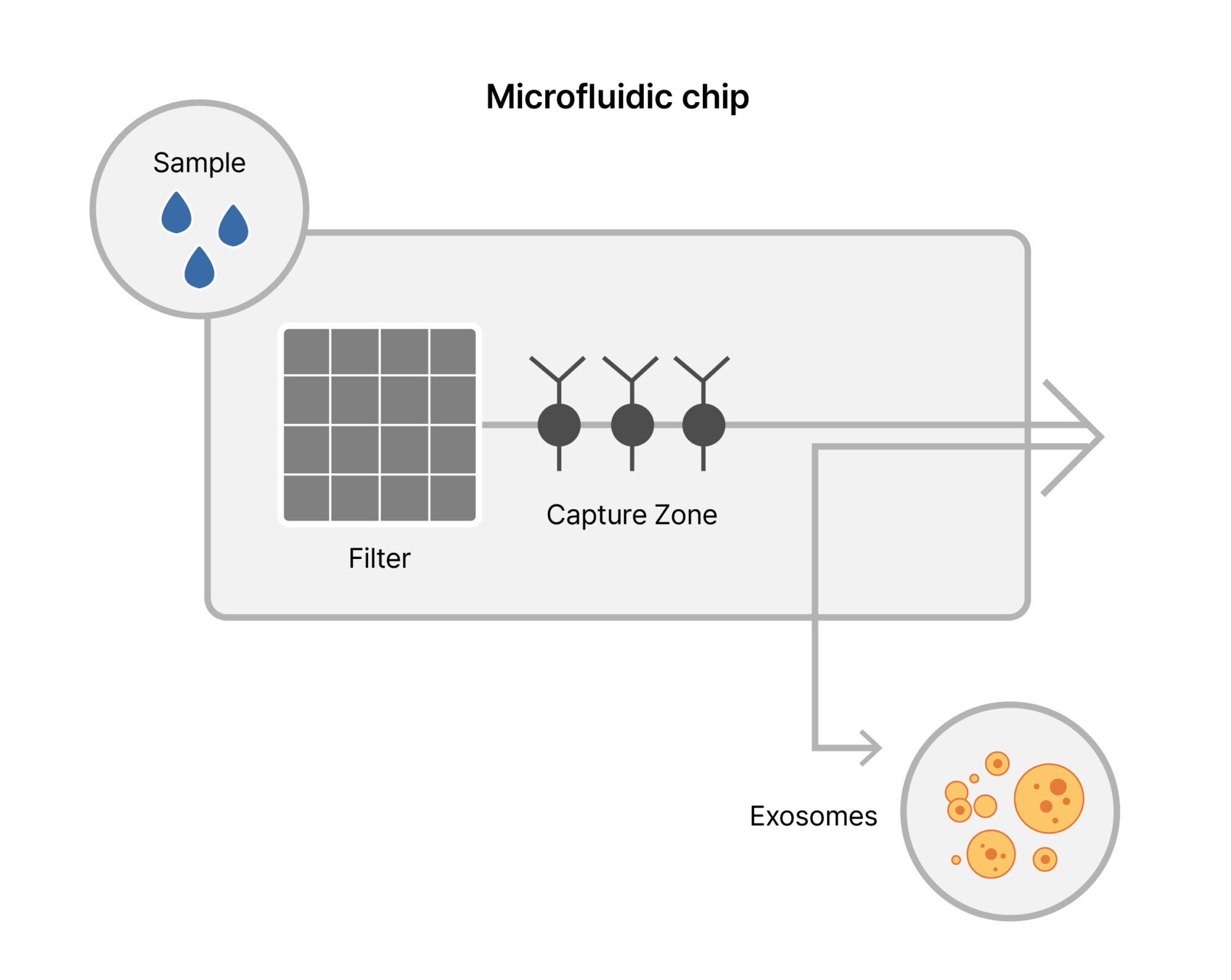
      Among recent exosome isolation approaches, microfluidic-based technologies are developing particularly rapidly. These palm-sized chips can integrate sample processing → isolation → purification → analysis within a single device, and are therefore often referred to as “lab-on-a-chip” technology.

      This approach offers strengths such as:
      • High-efficiency isolation even from small sample volumes
      • Well-suited for automation and standardization
      • Fewer process variables, enabling improved reproducibility

      Representative examples include:
      • ExoTIC : A size-based separation method using nanofilters, potentially achieving higher yields than conventional ultracentrifugation
      • Exodisc : A centrifugal disk-based platform with high protein removal efficiency, capable of rapidly processing ~1 mL-scale samples
      • Immunoaffinity capture (antibody–bead based) : Selective capture of tumor-derived exosomes using antibodies that recognize specific markers such as EpCAM and HER2

      Because of their automation potential, high throughput, and precise separation performance, microfluidic technologies are widely viewed as one of the most promising routes to accelerate the clinical adoption of exosome-based liquid biopsy.

Exosome Isolation Technologies Using Microfluidic Chips.


Figure 3. Exosome Isolation Technologies Using Microfluidic Chips.

The Present and Future of Exosome-Based Diagnostics


Exosome-based diagnostic technologies are advancing rapidly, and their potential is expanding further with the addition of artificial intelligence (AI) and machine-learning–based analysis. Because exosomes carry diverse protein, RNA, and DNA information simultaneously, AI can help interpret complex molecular patterns with high precision—potentially improving individualized risk assessment and increasing the likelihood of early detection.

One of the most closely watched areas is pan-cancer screening, meaning “multi-cancer screening at once.” Traditionally, different testing methods have been applied for different cancer types. In the future, however, panel-based technologies are being developed to evaluate multiple cancers from a single blood draw. If this approach becomes practical, it could fundamentally reshape the format of routine health checkups.

Exosomes may also play an important role not only in diagnosis but in treatment monitoring as well. They could potentially be used to:

  • Track treatment response in real time
  • Detect recurrence earlier
  • Identify signals of emerging resistance to targeted therapies or immunotherapies

This could accelerate the real-world implementation of precision medicine.

In addition, technological progress continues in the point-of-care (POC) space. Compact diagnostic devices that combine microfluidic chip technology with mobile devices are being developed, raising the prospect of rapid analysis even outside hospital settings. Such advances could expand opportunities for early cancer detection in regions with limited access to healthcare.

Of course, clear challenges remain:
  • Technologies to accurately distinguish exosomes derived from normal cells versus cancer cells
  • Reducing variability across isolation and analysis methods, and establishing international standards
  • Demonstrating clinical validity through large-scale prospective clinical studies
  • Developing platform technologies to reduce testing costs
  • Meeting approval requirements from major regulatory agencies such as the FDA and EMA

These issues will need to be addressed step by step for exosome-based diagnostics to be used reliably in routine clinical practice.

Conclusion: A Bright Future for Liquid Biopsy


Exosome-based liquid biopsy has shown great potential in the field of cancer diagnostics and is attracting attention as a new approach that may complement—or potentially replace—conventional invasive tissue biopsy. The possibility of using information obtained from body fluids such as blood to detect cancer at an earlier stage, monitor treatment response, and assess the risk of recurrence is highly meaningful for both patients and healthcare professionals.

In particular, research findings demonstrating the performance of exosome analysis in cancers that are difficult to detect early—such as pancreatic cancer—are raising expectations for future clinical application. However, these achievements are still primarily at the research stage. To be used as a real-world diagnostic test, multiple layers of validation are required, including standardized technologies, sufficient clinical evidence, cost-effectiveness, and regulatory approval.

With rapid advances in innovative technologies—such as microfluidic chip–based isolation methods and AI-driven analytical techniques—the clinical scope of exosome-based liquid biopsy is expected to expand gradually. If these technologies become reliably established, we may eventually enter an era in which routine screening can assess multiple cancers through a single blood test.

If we can learn to read these tiny “messages” sent by cells more accurately, we will be able to detect disease earlier and respond with greater precision.


This article is intended for informational purposes based on recent research trends and does not replace medical advice. For diagnosis and treatment, please consult a qualified healthcare professional.


REFERENCES
ⅰ Xu C, Xu Y, Han H, et al. An exosome-based liquid biopsy for non-invasive, early detection of patients with pancreatic ductal adenocarcinoma: a multicenter and prospective study. Presented at AACR Annual Meeting 2024, Abstract 3899.
ⅱ Raghu Kalluri, Valerie S. LeBleu ,The biology, function, and biomedical applications of exosomes.Science367,eaau6977(2020).DOI:10.1126/science.aau6977
ⅲ Schorey JS, Cheng Y, Singh PP, Smith VL. Exosomes and other extracellular vesicles in host-pathogen interactions. EMBO Rep. 2015 Jan;16(1):24-43. doi: 10.15252/embr.201439363. Epub 2014 Dec 8. PMID: 25488940; PMCID: PMC4304727.
ⅳ McKiernan J, Donovan MJ, O’Neill V, et al. A Novel Urine Exosome Gene Expression Assay to Predict High-grade Prostate Cancer at Initial Biopsy. JAMA Oncol. 2016;2(7):882-889.
ⅴ Li P, Kaslan M, Lee SH, Yao J, Gao Z. Progress in Exosome Isolation Techniques. Theranostics 2017; 7(3):789-804. doi:10.7150/thno.18133.


Looking for the Korean version? Click here.


Logos Biosystems provides a diverse portfolio of automated cell counters designed to meet various laboratory requirements.
To learn more, visit www.logosbio.com.